Trip report: Proof-of-concept on the Freshfields Icefield
I woke up that morning after the windstorm, and heard my teammate say, "oh, holy f***"…
Yup, that was an unexpected turn of events… but first let’s rewind to where this all started:
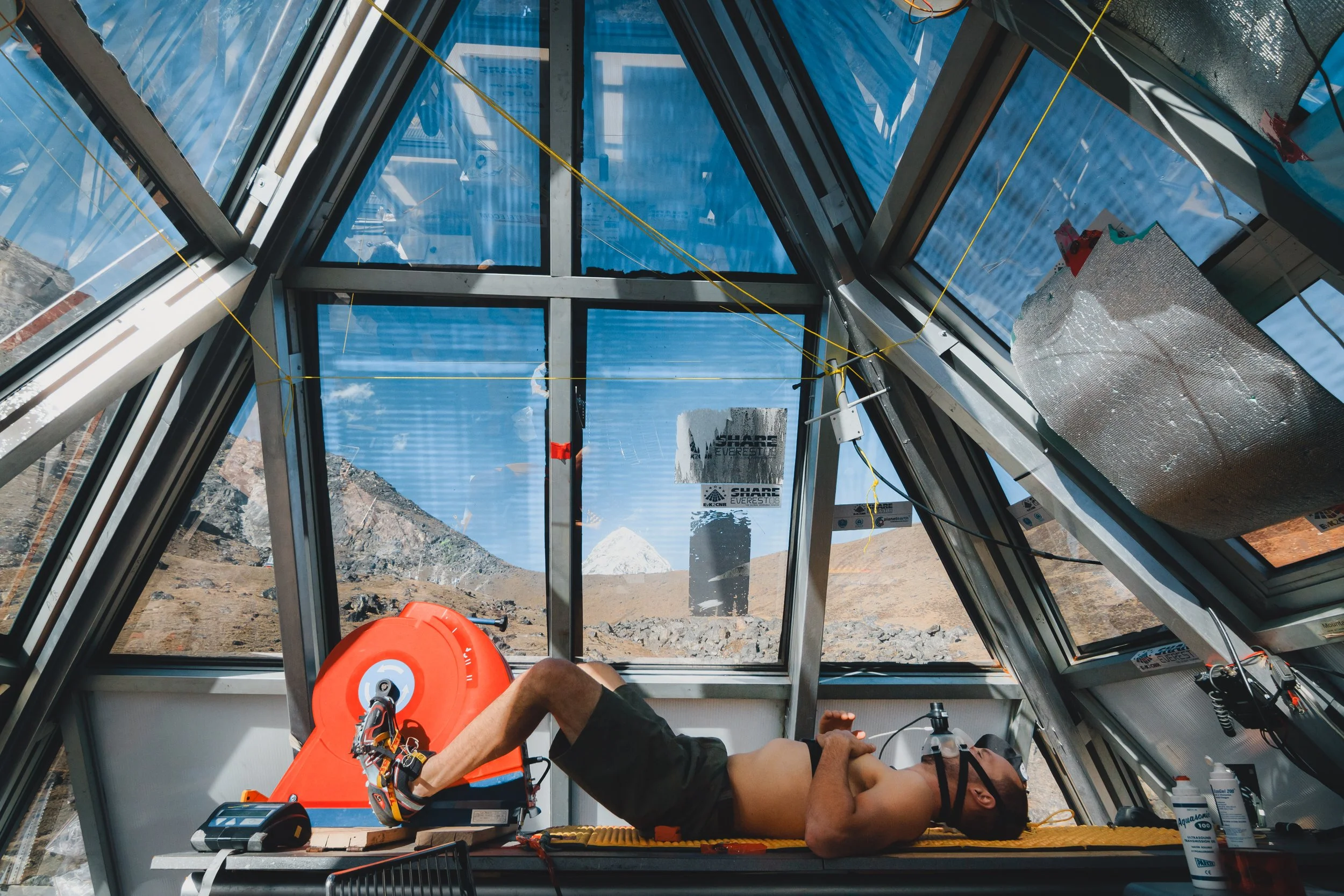
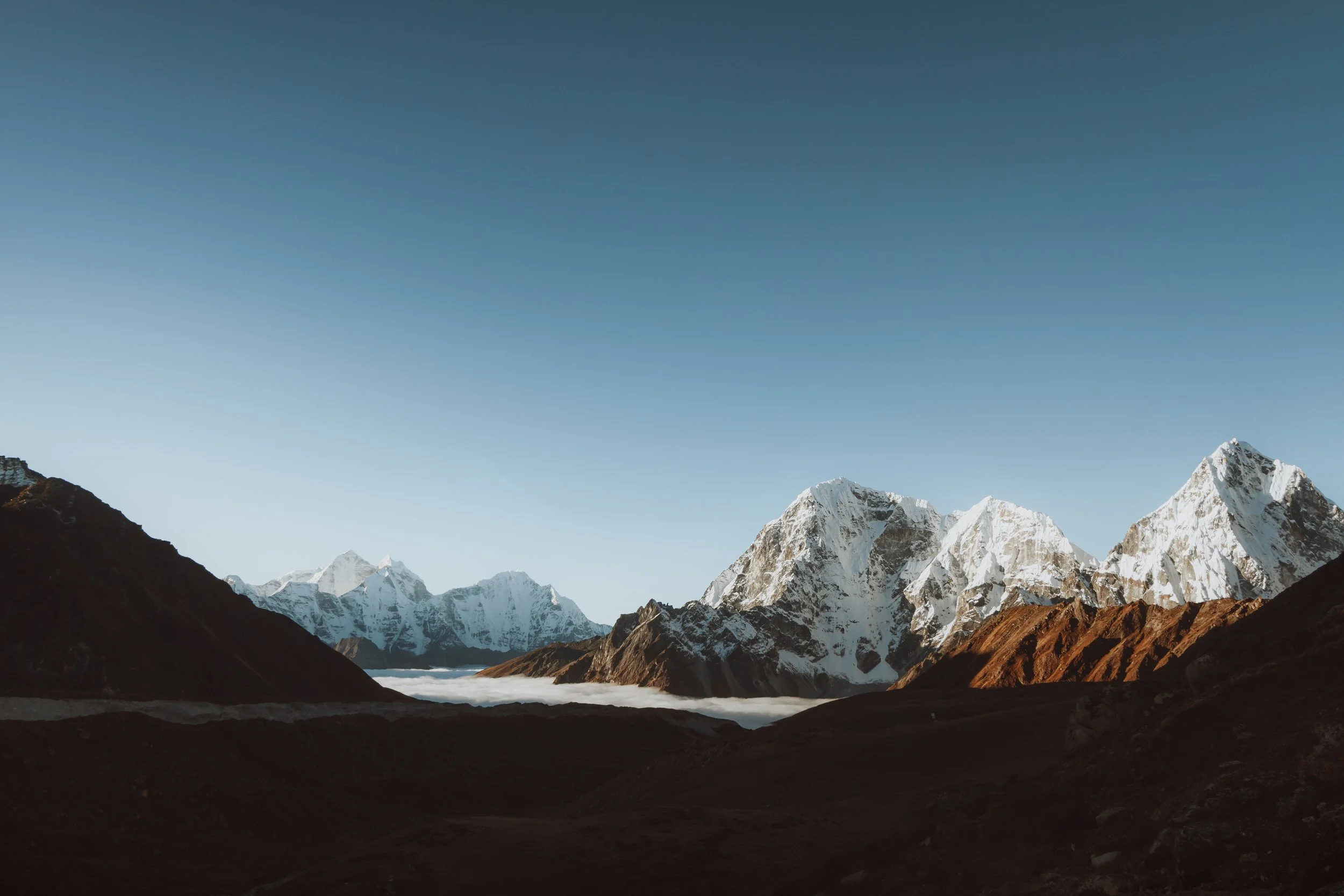
For those unfamiliar with my story, I have a background (and continuing involvement) in high-altitude research. After completing my PhD as a cardiac physiologist in 2016, I went on to join several high-altitude research expeditions across the world, including the Ev-K2-CNR lab in Nepal, Cerro de Pasco in Peru, and White Mountain in California. These were the highlight of my academic career, and easily some of the coolest experiences of my life to date. More on the academic history another time.
The call.
Anyway, last September, I got a message from a colleague at the University of Calgary.
"Hey Alex, I was wondering if you want to chat about being part of a research expedition we are planning... it's to Mount Logan in the Yukon."
"Whoooaaa hell yeah!" It took all my will not to respond in all caps with “ARE YOU FKIN KIDDING ME”. This was insane. The thought of doing the research I love, on the tallest mountain in Canada, was next-level life epicness. Plus, of course, I suggested I also document the entire thing with my camera. More on that soon.
Since that conversation we've assembled a team of around twenty incredible researchers, doctors, guides and mountain enthusiasts (aka willing research participants who live for type II fun) for the Logan expedition. Our main go will be to assess, for the first time, both women's and men's physiological responses to a high-altitude ascent. This is quite literally something I’ve wanted to do since joining these expeditions: there is a massive underrepresentation of women in physiological research, and my PhD work was actually focused on differences between female vs. male hearts and cardiovascular system, including their regulation by our nervous systems. Exposure to low-oxygen environments, including high altitude, have profound impacts on the cardiorespiratory and nervous systems, so it’s my hypothesis that these might contribute to different physiological responses in females vs. males. But, we’ve never had a high enough number of women in our expedition teams to properly power our comparisons… until now. So you can imagine my scientist brain is pumped.
Perhaps I need to do another write-up about that as well. Let me know in the comments if that’s something you want to read more on!
Proof-of-concept.
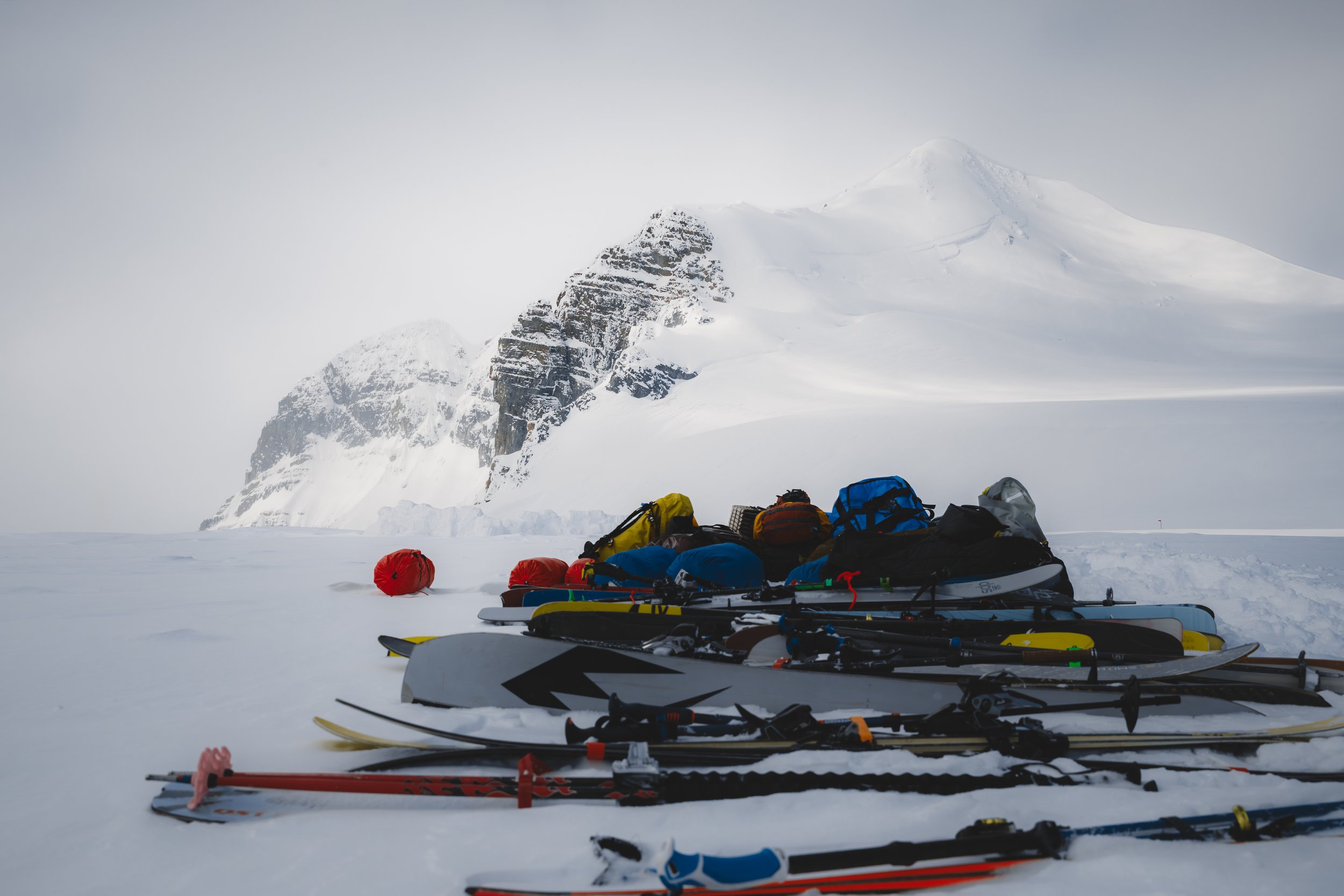
Alright so now that we had the team, fast forward to this April, we were all coming together in person, as a team, for the first time for sort of a "test run" ahead of the main expedition. A “proof-of-concept”, if you will. We were heading to the Freshfields Icefield, right on the edge of the BC-Alberta border, with three main goals:
Vibe check. Gather the team to convene on logistics, expectations, and suss out the energy. Teams need to be cohesive and aligned in challenging environments, as Logan certainly will be, so it’s always a good idea to see how we all do in similar environments ahead of the full endeavor
Simulate the conditions and terrain for Logan. It’s going to be cold, windy, and harsh. We’ll have glaciers and broad terrain to navigate, decisions to make based on weather and any other “events”.
Dial in expedition-specific skills. We’ll be rigging and pulling gear sleds, plus this allowed us to test our camp setup including power, research equipment and cooking facilities.
I also had a few things to “test run” myself. While I’ve been on several research expeditions none have been as remote as this, and I’ve admittedly not done much more than a few overnight winter trips in tents. So for one, this was simply proving to myself that I'm capable of proper winter camping. That then also came with the question managing my Raynaud's. I've had some pretty rough experiences at altitude where my fingers and toes become very prone to frostbite… those temperamental little blood vessels like to really constrict in high, cold places. So heading into a glacier camp with overnight temperatures around -20C, I really had to dial in my strategy and gear.
I prepared as carefully as I could: I had five types of mitts and gloves, tons of hand warmers, and even pair of electric-heated socks I'd picked up for a wilderness first responder course last winter though with uncertainty of how long the batteries would actually last. For footwear, Intuition came through with a pair of their camp booties, which I’d later realize were a life saver and exactly what I needed at camp (I also brought “heavy hiking boots” which was a sh*t idea don’t do that lol). For my sleep setup I was stoked to have Zenbivy's -5F / -20C down quilt and bed setup, paired with a solid winter expedition mat. I was low key impressed at how well these all packed down, in my previous trips I was definitely extra novice with “all season” gear, aka not warm enough at all oops.
The landing.
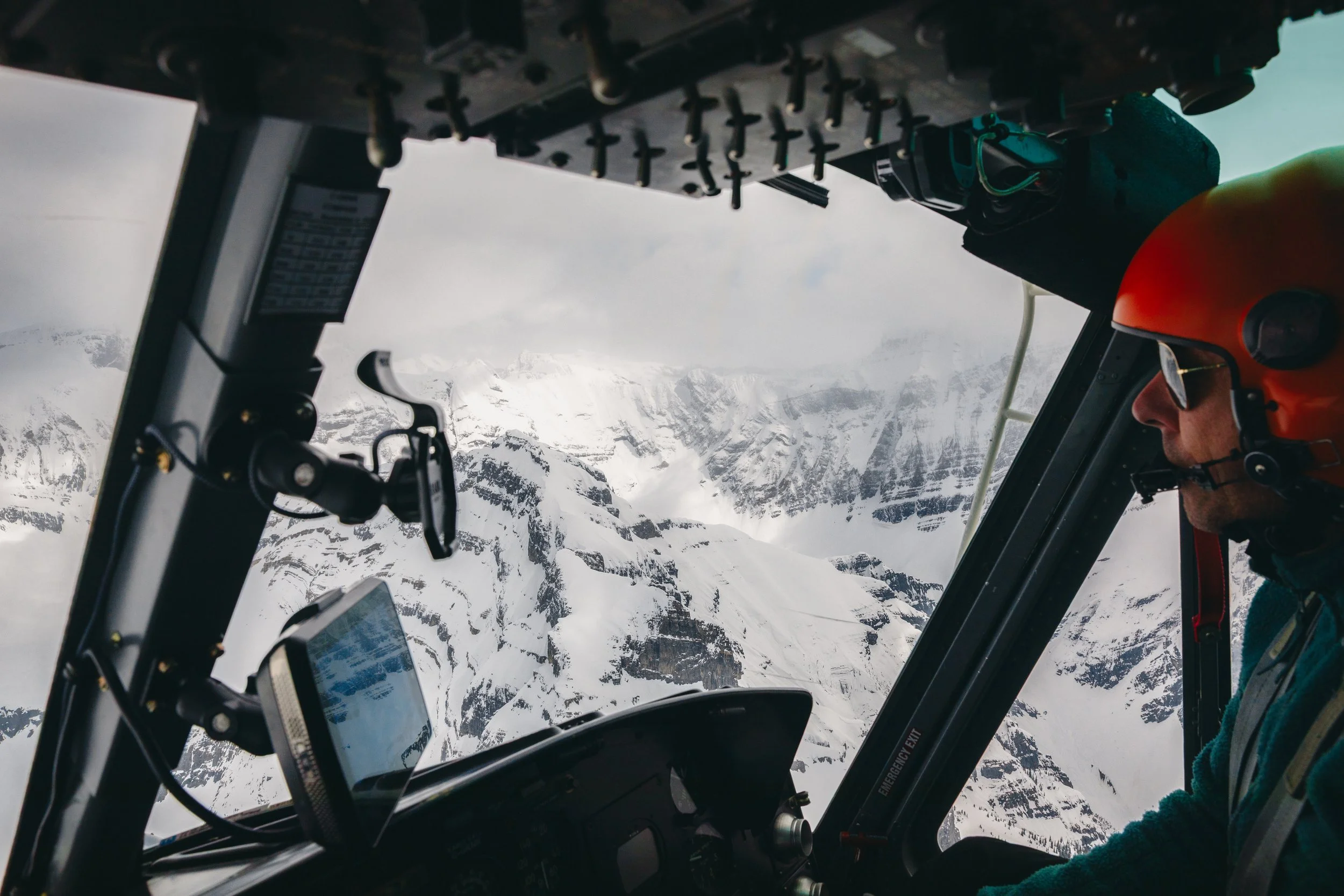
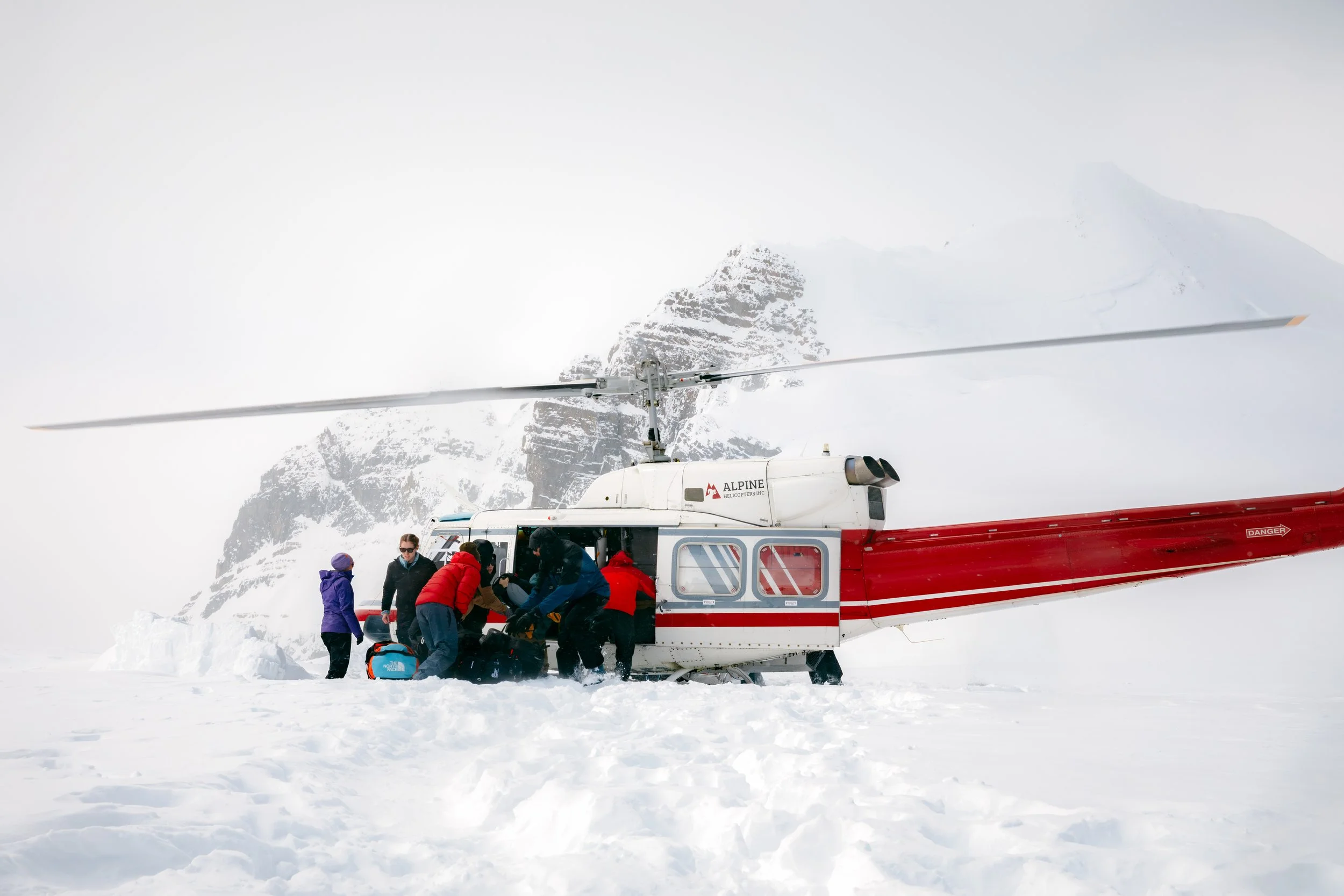
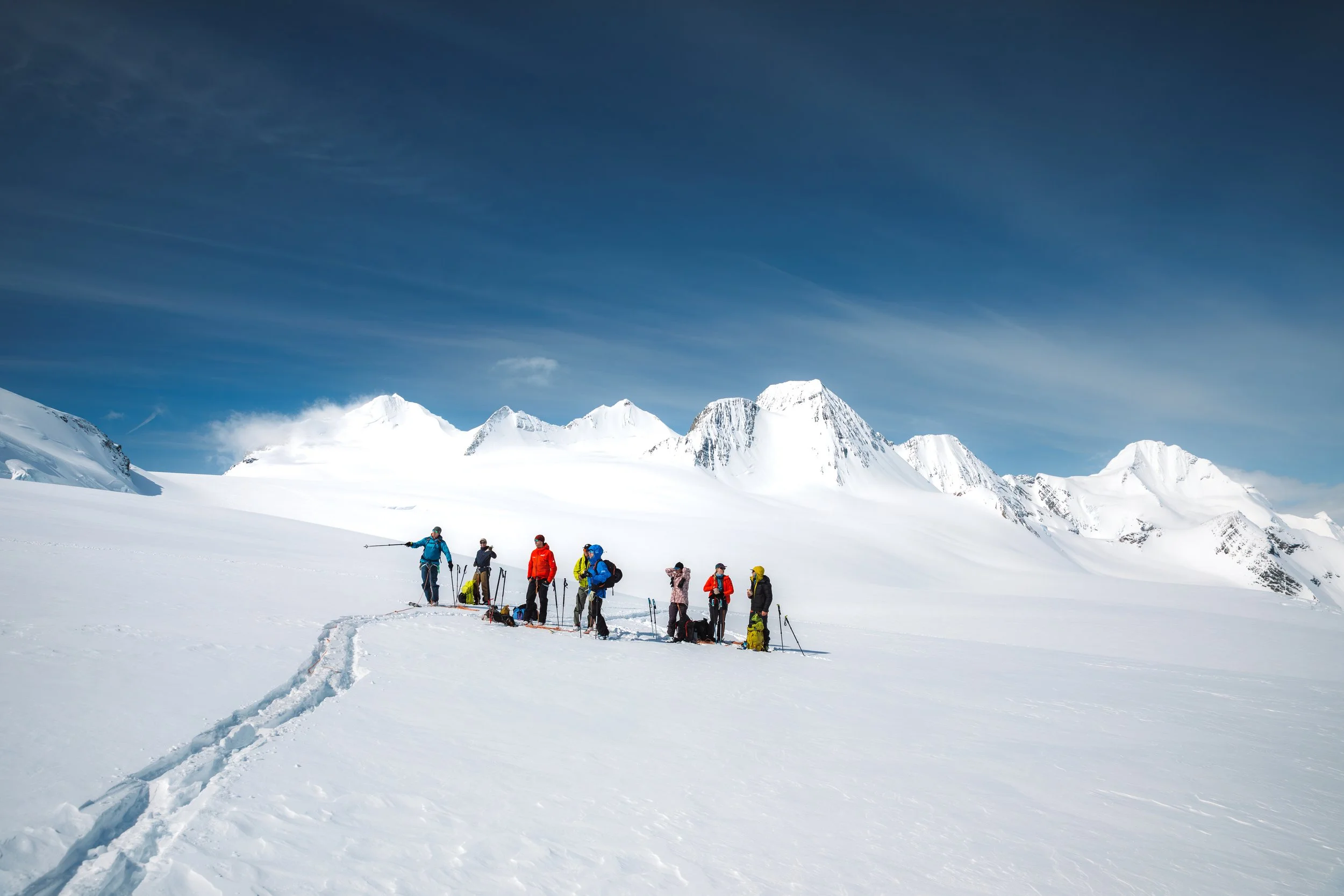
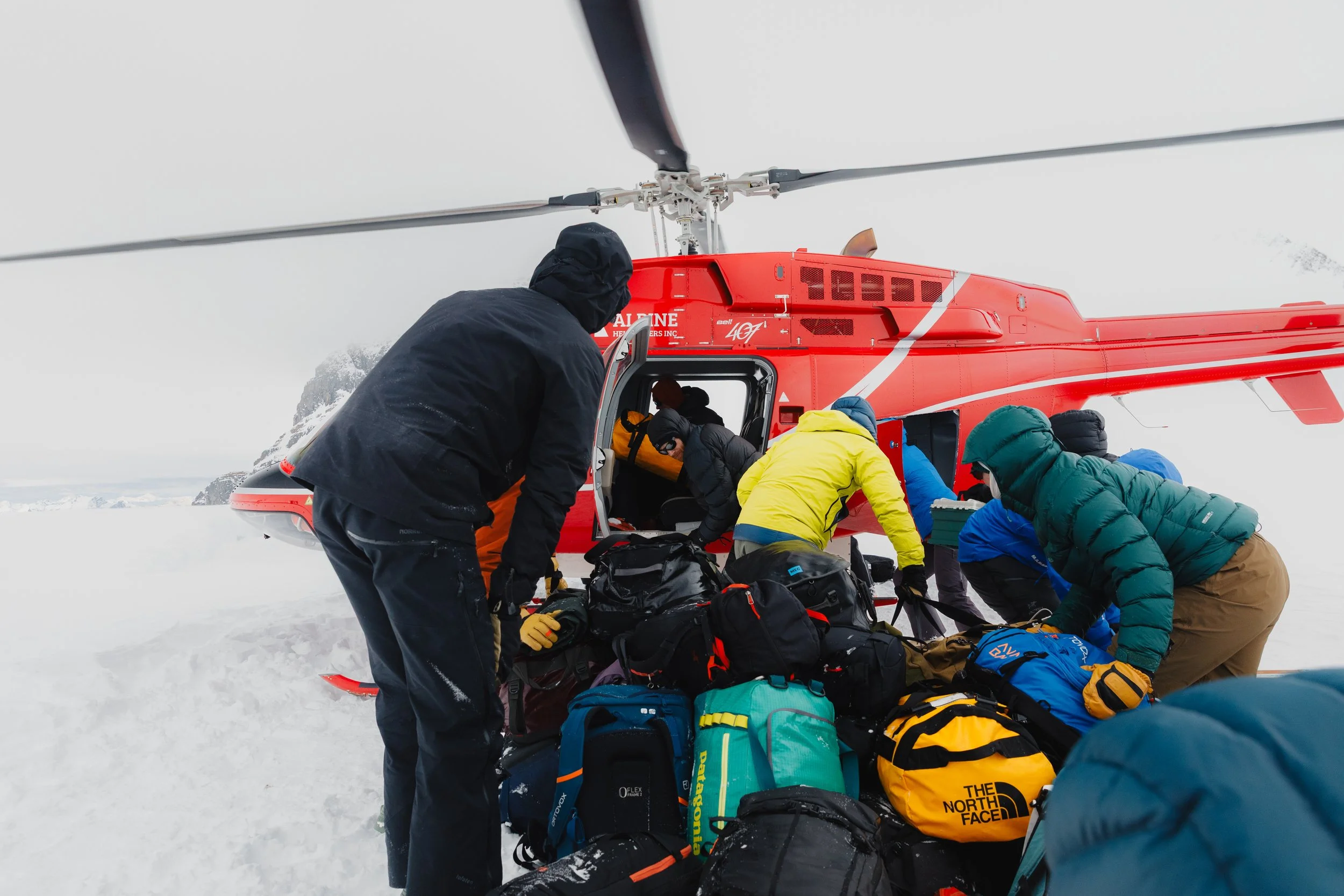
After meeting at U of C’s Outdoor Centre to go through gear check and logistics the day before, we made our way to Golden to fly in with Alpine Helicopters. I'd only ever been in the smaller six-person aircraft before, so being told we had a fourteen-person helicopter was beyond cool. The thing was absolutely massive. We moved twenty-two people and all the gear in three flights.
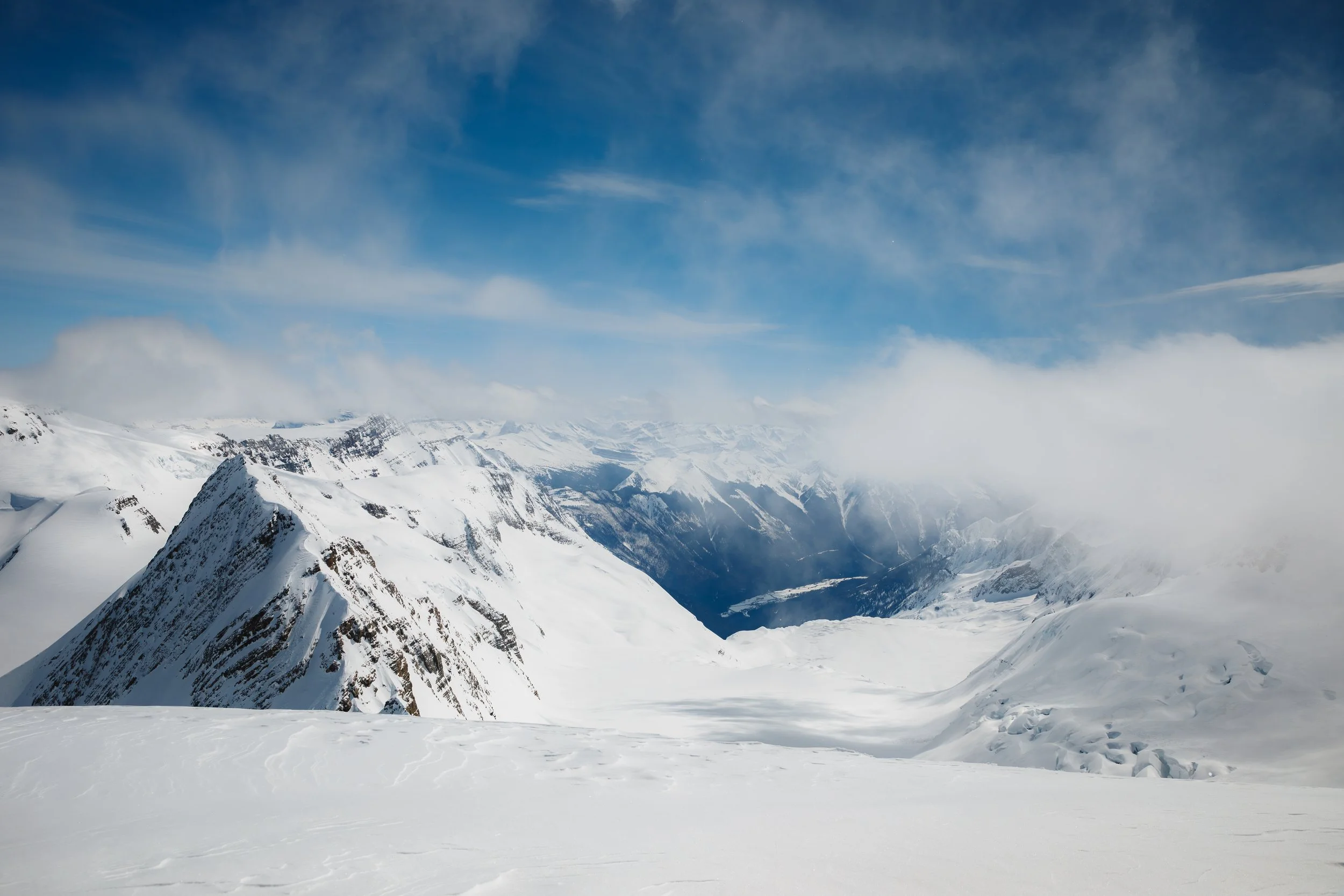
Being the nerd I am, I'd already looked over the topographic maps and satellite imagery for the icefield ahead of the trip. Based on the itinerary I'd assumed we'd likely be camping on the flats around 2200m as a solid central point to access the surrounding peaks. But to my surprise, as we passed over a high ledge between two peaks, the helicopter circled back and set us down on this higher plateau. We checked our GPS: it said we were at 2950m. Being this high up, the view looking west was insane. You could see the BC Rockies and Columbia mountains all the way back to Glacier National Park. I’ll show a map and photo lower down, obviously I geeked and checked on Google Earth to compare. This was easily the most incredible base camp location I've ever seen.
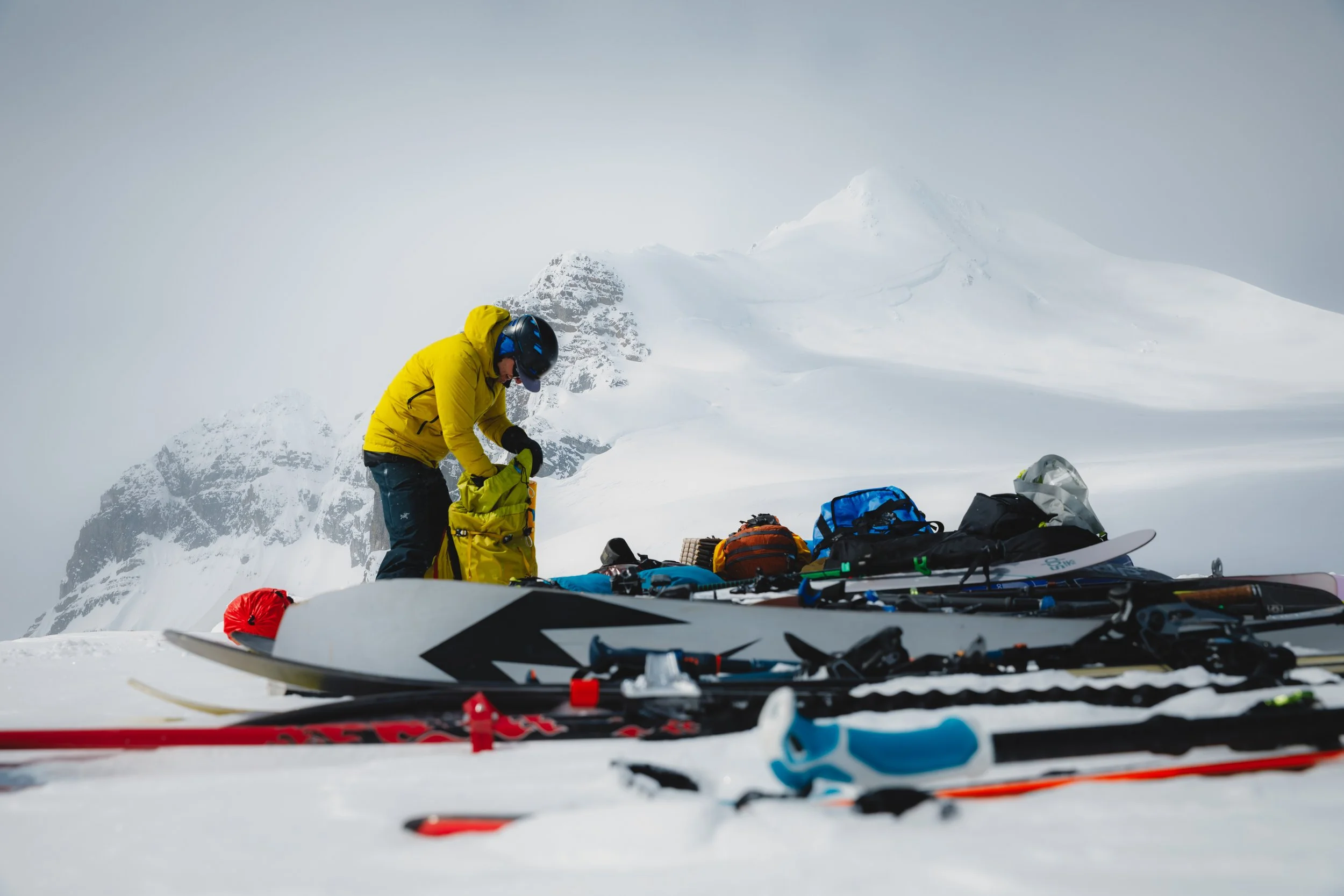
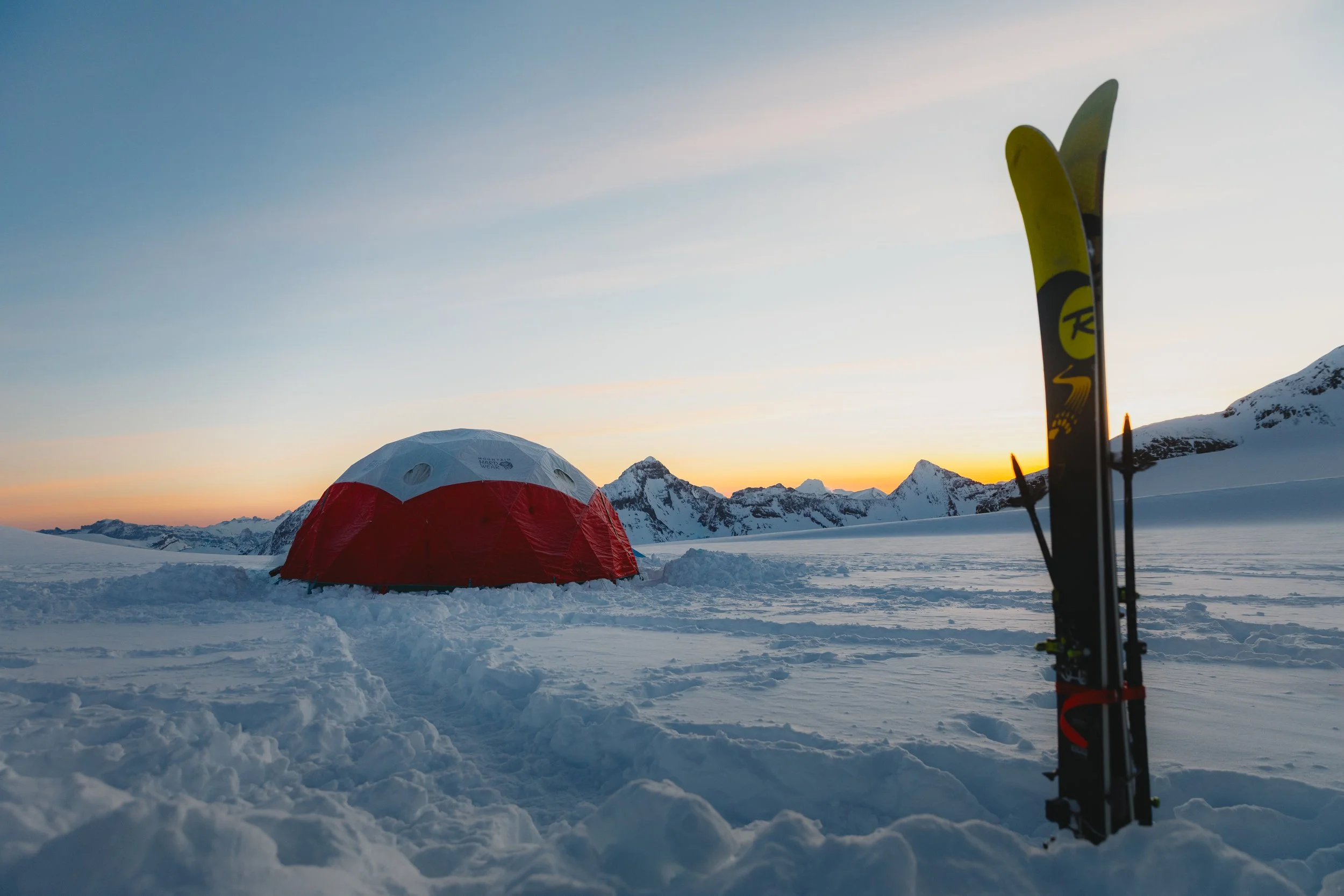
After landing got to work organizing gear, digging our tent pits and setting up the base camp dome. It was one of those Mountain Hardwear structures with what appeared to be a bazillion different tent poles going in a bazillion directions, lines dug deep into the snow, big enough for twenty people plus all our cooking equipment. "Pretty much bombproof," someone said. File that one away for later.
On the ice.
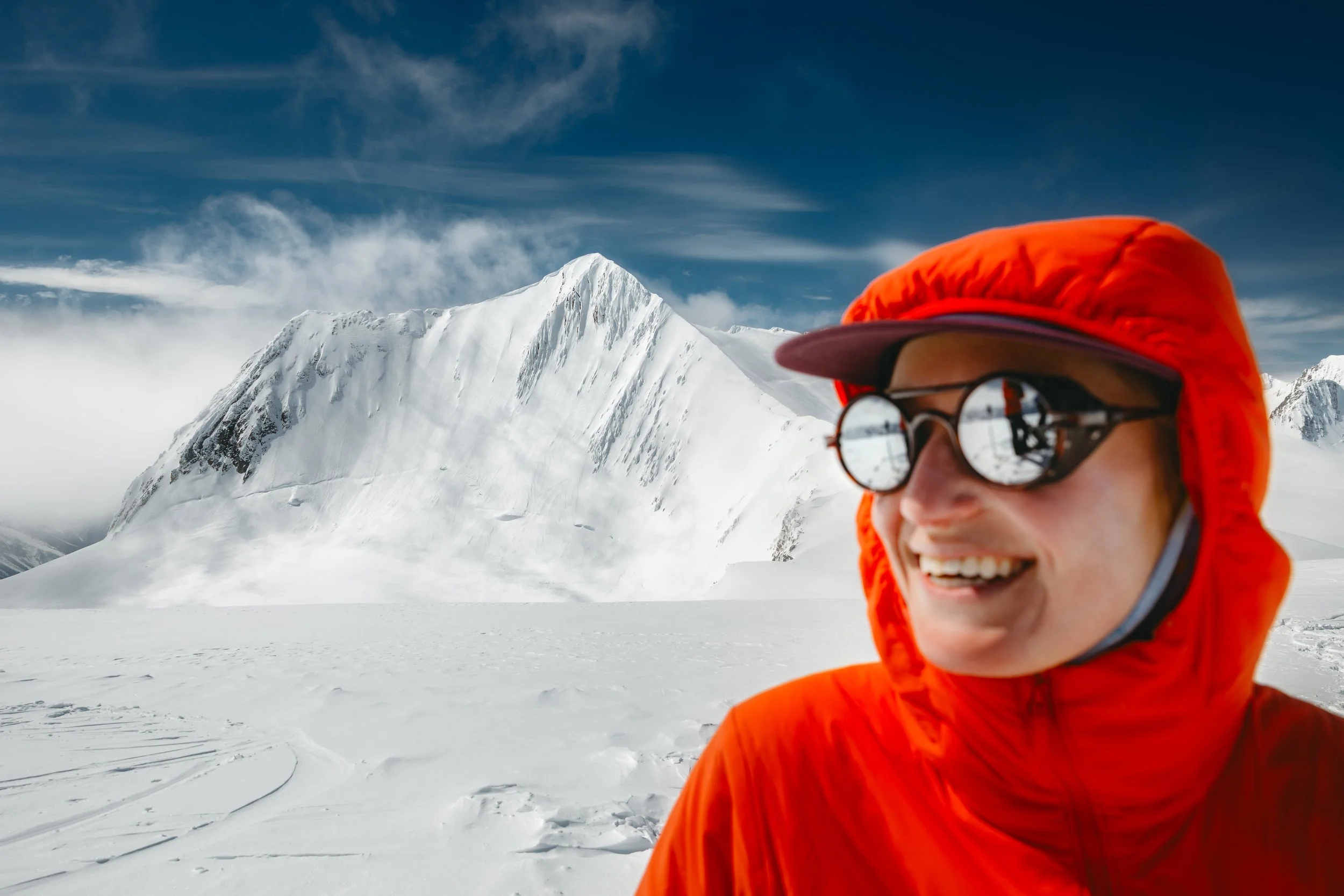
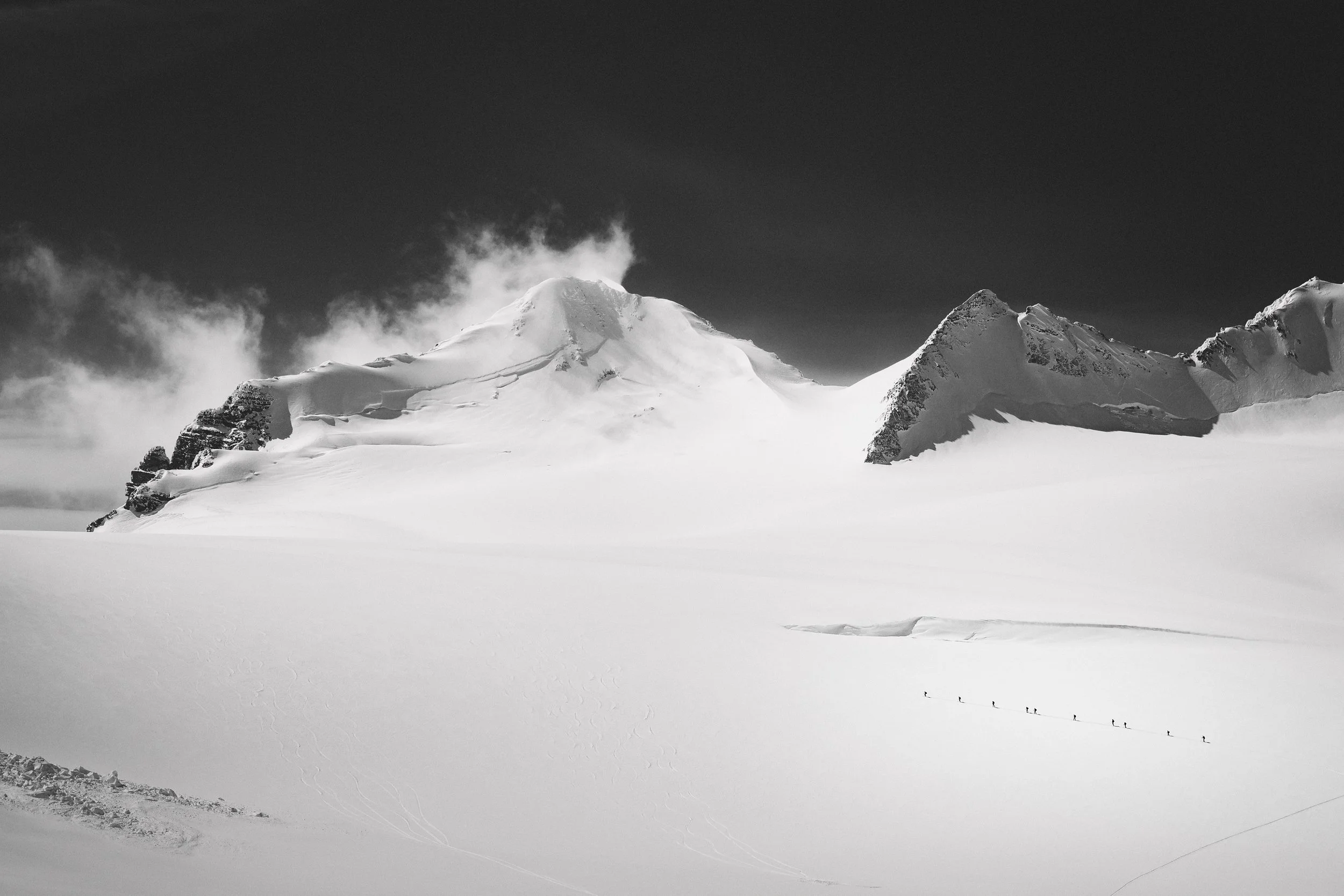
Our first full day in the field was the shakeout ski: starting with a quick refresher on avalanche knowledge, then we were off in our rope teams, skinning toward a drop into the lower valley. It was a perfectly gorgeous day, blue skies and the sun warm enough that it didn't actually feel as cold as the air temperature was meant to be. I set off down that first descent thinking, this might actually be my first proper set of “ski squiggles”, I've never been on such untouched terrain before. The snow was soooo buttery and fresh and lovely, and it was just us out there, surrounded by all of these amazing summits. It all felt so magically remote and pristine. "How's my squiggle?" I asked my friend at the bottom. "Buddy, those are some quality squiggles!" I looked back up the slope and he wasn't lying. I felt really good about it, given that leading into the trip I felt like one of the less experienced backcountry skiers on the team. So that was cool.
We skinned back up and made our way to a nearby summit with spectacular views looking out toward Golden and beyond. The stoke was high, not necessarily because we had done anything particularly challenging, but for the joint joy and awe of being in this place, and realization that we had so much more of this to come as a team.
That afternoon we got some crevasse rescue practice in, then pulled out some of the research equipment to play and demonstrate with. I got to test out a new toy: a handheld cardiac ultrasound, basically the size of a tablet (usually we would have large laptop-sized ultrasounds, but those are way too heavy and demanding for this type of environment). And for our crew who were there as participants, they got to see some of the setup and the tests that we would be doing in the field.
A shift in the winds.
Day two wasn't quite as shiny as the first. It was a bit warmer, but we had lots of wind and super low visibility. That said, the whole point of the trip was to experience this weather and variability, so in a way that was welcome.
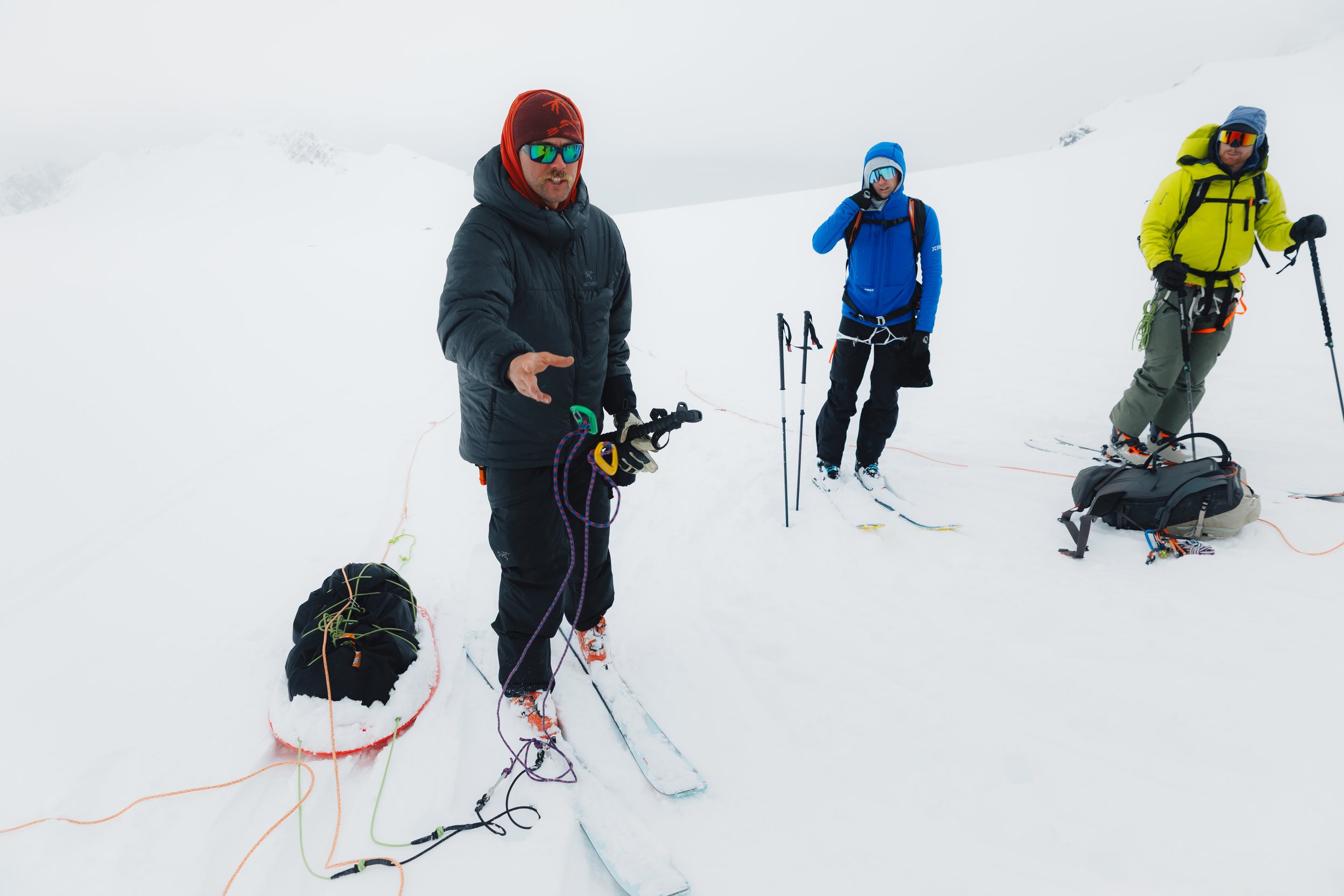
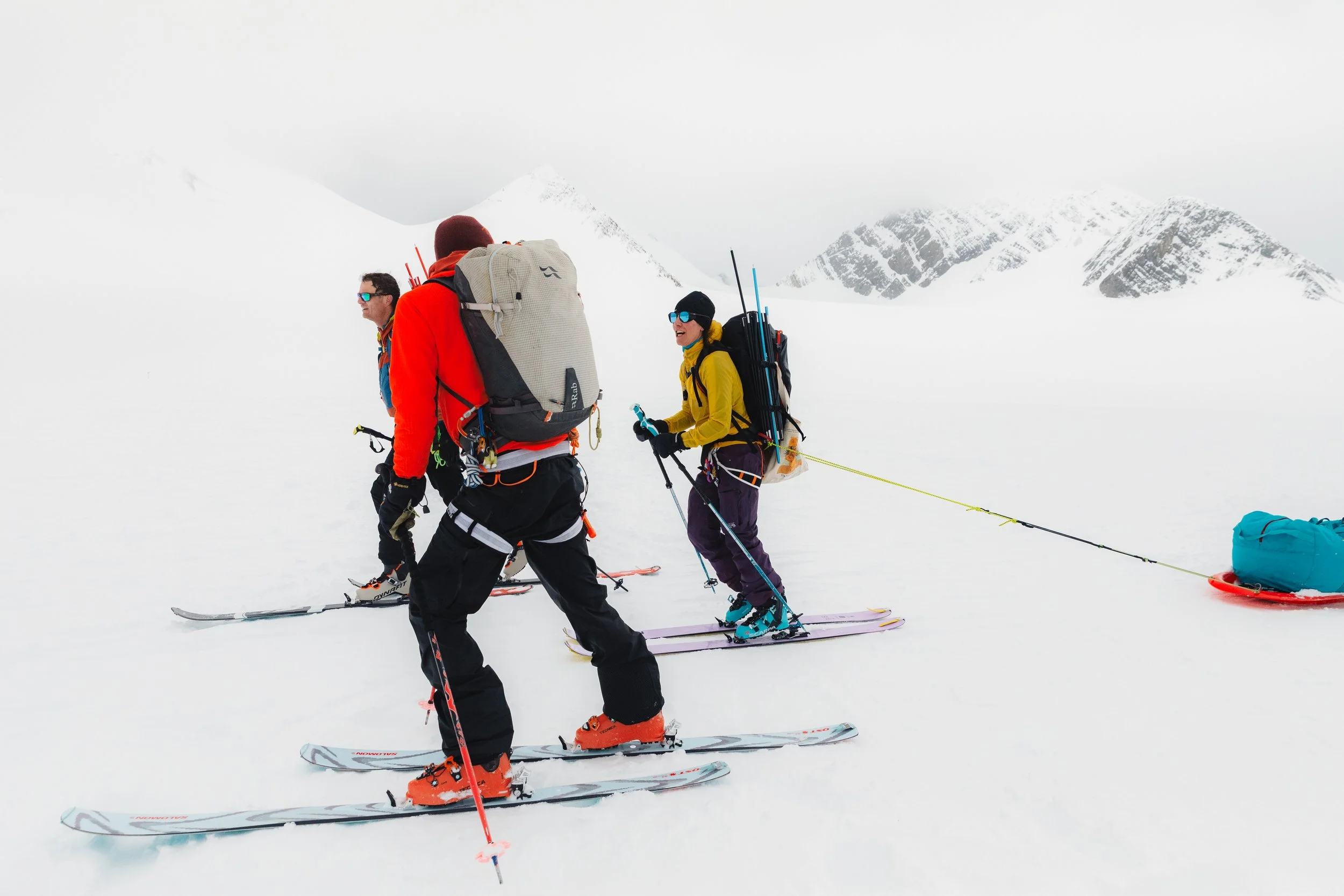
We set off to learn how to rig and pull the gear sleds, which is something all of us will be doing on Logan given the length and equipment demands of the expedition. After rotating through sled pulls and making our way up toward the col between two of the nearby summits, we went for a “quick rip” up one of the slopes. When I say we couldn't see anything, I mean it genuinely felt like skiing into an abyss, which I am again not the most confident in lol. But luckily a strong team around you helps ease the nerves, and I kept thinking “Alex, you do this at Whistler all the time. You’re fine.” With some slightly-less-cute turns than the day before, I made it down with the team and we went to retrieve the sleds.
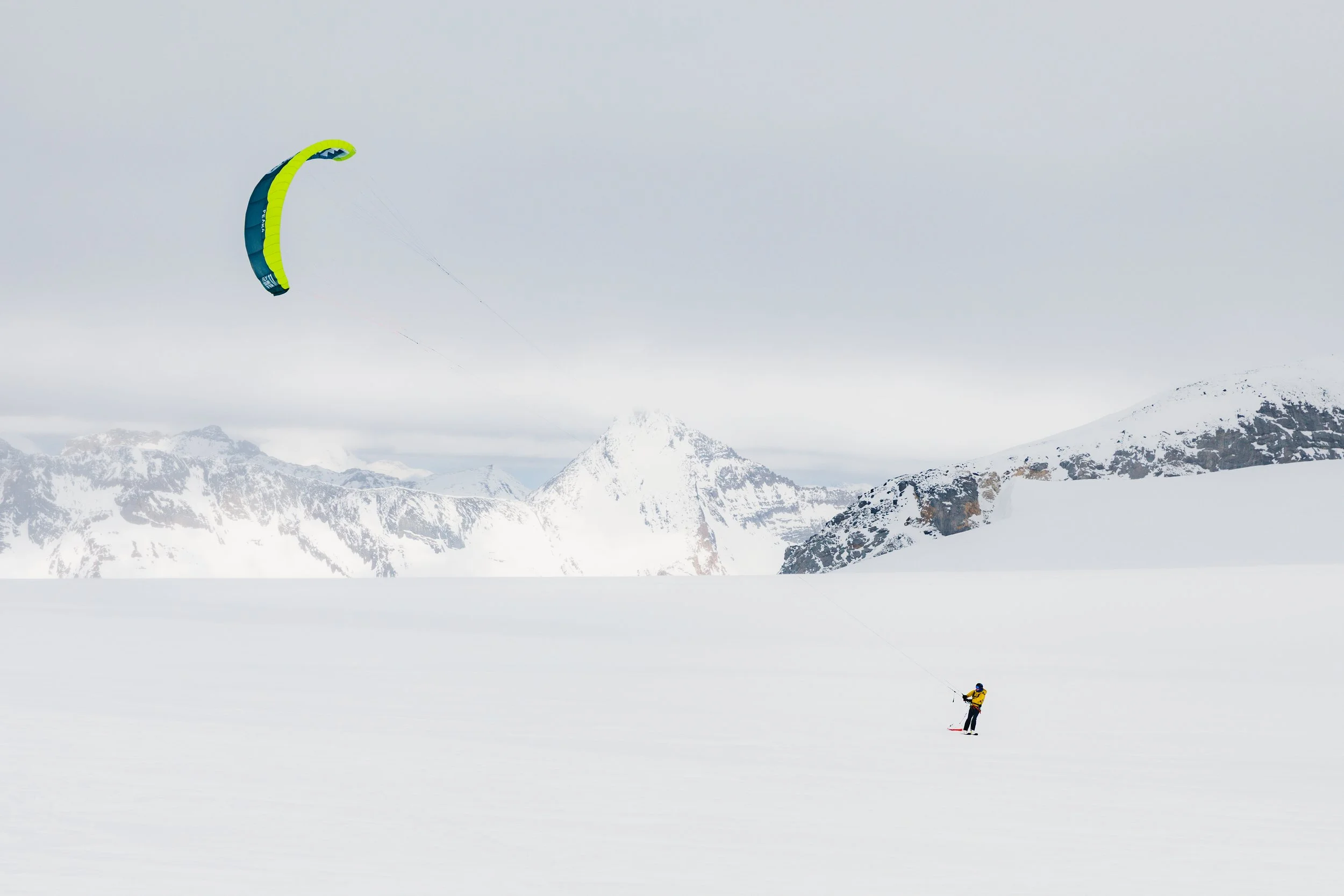
As we made our way back to camp the wind felt like it was getting worse but the sky started to open up, and we could see the range again. And somehow, a few of our crew had brought kites and managed to rig them up to the sleds and drag them across the field. Whether that’s going to be practical on Logan or not, I was absolutely entertained and we need to get these guys a kite sponsor!
That evening as it got into golden hour and then blue hour, the lighting on the mountains out west of us was absolutely freaking incredible, to the point that I kept running back to my tent for my camera and then running back out again as it got better and better. All of us were out there at one point just screaming, “HOW IS THIS REAL?!”
When we got home I checked on Google Earth and confirmed we had at least seventy-five kilometers of visibility from that plateau, with Sir Donald and the Rogers Pass peaks laid out to the west. How freaking cool is that?
Around dinner that evening I had checked the weather models to see what conditions we were in for the next day. We were planning a longer day of skiing and potentially another summit objective, and it looked like the winds were meant to calm down overnight, and maybe get gusty again the next afternoon…
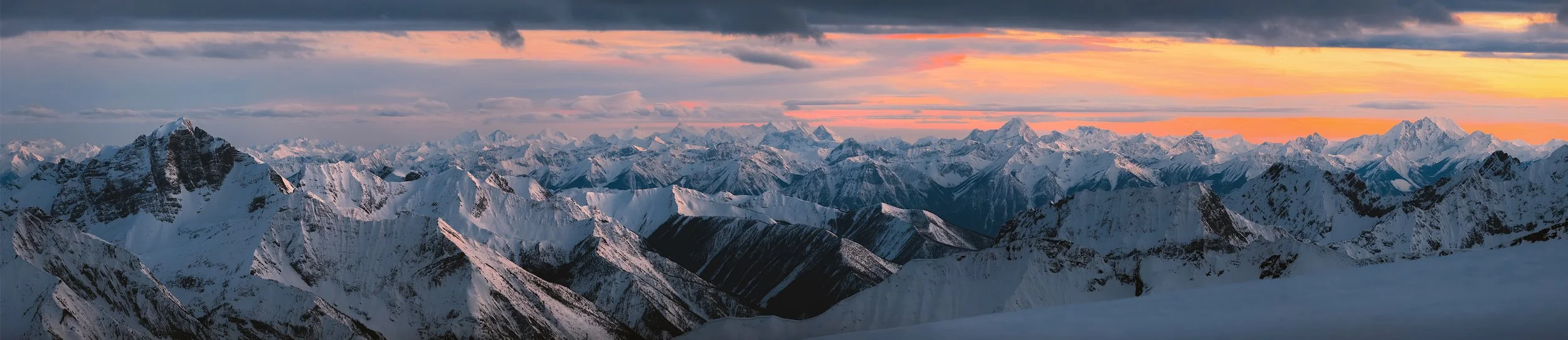
Panoramic view looking west at British Columbia: the Canadian Rockies and Columbia mountains further in the distance (spot Mount Rogers and Mount Sir Donald)
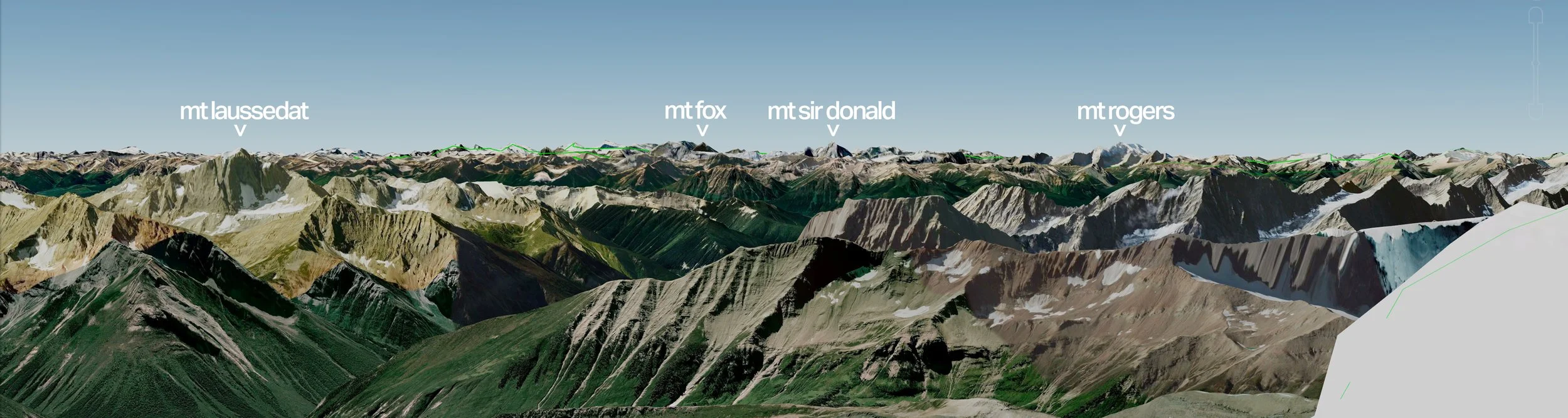
Google Earth for comparison. Our line of sight easily extended ~75km to Glacier National Park.
The “disappearing act”.
Well, it did not calm overnight.
Around 01:00 I woke up to my head and feet getting slapped by my tent and the winds outside. In a daze I was partially question whether my fly might rip away but then realized that was near impossible. Also we were dug in so deep, nothing was going anywhere. I set my alarm for 06:15 because my group was on breakfast duty, and did my best to get some sleep.
I woke up ahead of my alarm at 06:00 and heard some rustling. Then, the voice of one of the calmest, experience people on our team say out loud, "oh, holy f***.”
I assumed maybe the basecamp has broken or collapsed. Or maybe the camp beyond us had issues.
I scavenged for my layers, crawled out, and looked over to see a crater where the base camp had been. Basecamp was totally gone. Disparu. Snapped lines were sitting in the snow, the equipment inside the tent scattered in the remaining crater, and some more stuff dispersed down field where seemingly the dome had blown off. Quite the magic trick, eh?
This wasn't a drill, but it turned out to be a solid team test: nobody freaked out. In fact, it was quite the opposite: everyone responded and simply got to work. A few of us went straight to gather what had made its way down the field. Others started boiling water and built a wind shelter around the stove. Three of our strongest members took a sled and set off downhill to see if they could find it. It was like everyone had been through something like this before and just knew how to kick into calm, collective action. Our lead guide came out and said, "so everyone, this was obviously not a drill and you all did an amazing job responding and organizing with a situation frankly none of us anticipated. Well done."
There was a chance the helicopters might not be able to fly with the current visibility and potential incoming weather, so we only half packed and left the tents up, in case we might need to stick around. But an hour later the search team emerged over the rise hauling the remains of the tent on the sled behind them. It felt like one of those victorious scenes in an action movie, and the Indiana Jones theme was playing in my head haha. So epic.
We managed to get the helicopters confirmed and everyone packed up for descent.
And further proof this team is gold: while waiting between helicopter shuttles there were handstand competitions, an impromptu Taylor Swift sing-along, and a fruit by the foot race. So many laughs and the best vibes.
The proof.
Even accounting for the unexpected events, the trip was certainly a success.
Vibe check: fully yes. Half of us hadn't met before this trip, and even at the point that we were digging our tent pits on arrival, it was already clear everyone was on the same page. Regardless of variations in backgrounds and experience, what’s most clear to me is the values, work ethic and level-headedness of each person on the team collectively clicks. Everyone brings their own flare and specialty, work ethic and appreciation for what we’re all trying to achieve (plus, what our priorities are as a research team rather than a summit team). I have a very good feeling about this crew.
Simulating the conditions: affirmative haha. While Logan will probably be colder and harsher, the cold and wind we encountered was a solid test. Not to mention the relatively unpredictable and quick shifts in weather and visibility that we encountered through our time up there. Plus, while the unexpected event with our basecamp wasn’t Ideal, it was certainly a reminder of “anything can happen”, and it allowed us to talk through the different outcomes and team plan if we hadn’t been able to get a heli out that day. Logan is certainly going to require patience and flexibility.
Dialling in skills and systems: this was an awesome intro and extension to certain skills, the sled pulling being relatively new to everyone. I think each of us has walked away with a good sense of what we individually want to work on through the year, and how we want to approach next year’s ski season to feel as ready as possible for the expedition.
This was absolutely one for the books.
Onward and upward.
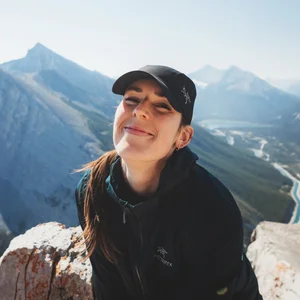
Alex Mack is an adventure photographer, ACMG apprentice hiking guide, and high-altitude physiologist based in Vancouver, BC. She writes about mountains, photography, and the space where science meets adventure.
With appreciation that the lands known today as Canada are home to the enduring presence of all First Nations, Métis, and Inuit peoples. We acknowledge the past, present, and future generations of these Nations who continue to lead us in stewarding this land, and honour their knowledge and cultural ties to this place.